Saturday, 3 July 2010

New Forest weekend - Needs Ore Point

Our second day started out at Needs Ore Point, a private reserve sticking out into The Solent (the body of water between the mainland of Britain and the Isle of Wight).
There were several hides to take a look in and also right down the end of the spit, this view across to the Isle of Wight. Below are some of the birds we saw here. Little Egret

Grey Heron
Curlew taking a drink....


Some Black-tailed Godwits in varying stages of summer/winter plumage. A bit distant unfortunately!
A lone Lapwing (usually seen in flocks).
Lastly some Oystercatchers (or Oiks for short).


The final post from the New Forest will be back in woodland as we make our way back north towards home.

Thursday, 1 July 2010

New Forest birding Day 1 - part 2

Having spent the morning meandering over the heathland, the hot weather drove our leader (Jane) to find shade for the hottest part of the day. Late June in the afternoon isn't the best time in the world for birding generally, nevertheless we picked up some nice woodland birds including Great-spotted Woodpecker, Willow Warbler, Blackcap and Treecreeper.
The shady canopy was a blessing!
In this particular area Birch seemed to be the dominant tree.
You might think I'm mad, but I was really chuffed to get a photo of this usually shy bird, the Stock Dove. They breed in wooded areas but generally it's hard to get close looks at this bird. The usual sight of them is of distant flying birds! This particular one was serenading us with is monotonous but soothing song.
Even the ponies were finding places to stay out of the sun!
I liked these sun kissed sculptured trunks.
The graceful Foxglove is a feature throughout the Forest.

After dropping off our 'stuff' at the Hotel B&B, and a delicious dinner at the Beaulieu Road Station pub, we headed for heathland again for some evening birding.

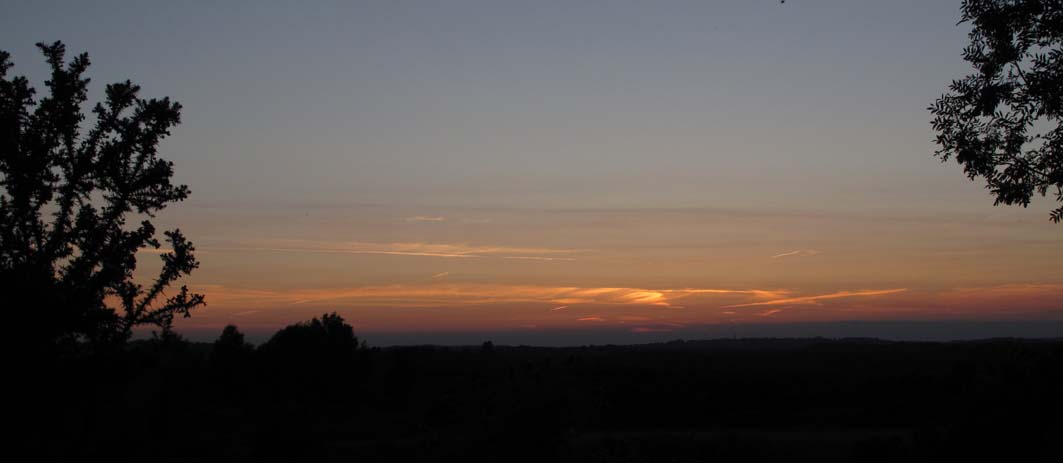
Watching the evening sunlight across the heath was a beautiful way to end the day.
We were hoping to see an heathland specialist here (the Dartford Warbler). We had no luck and we all wondered whether the harsh winter had taken it's toll on the population of this bird in Britain. Only time will tell.

As the sun went down, our target bird was the enigmatic Nightjar. There were no real sightings during the evening but some of us heard distant 'churring' and apparently, I nearly stepped on one in the dark going back to our cars!!!
The next two shots are slightly out of sequence, sorry! Just a couple of photos of the inevitable ponies grazing peacefully.

As the sun set we slowly made our way back to the cars.
My final shot of the day was the moon rising up through the Forest trees.

Tuesday, 29 June 2010

New Forest Birding Weekend - Day 1 part 1

This last weekend I went on a Bristol Ornithological Club trip to the New Forest in the county of Hampshire. The New Forest is about 1.5 hours south east of where I live and is mostly a mix of heathland and ancient Woodland. There were 12 of us on the weekend and here are some of the group striding out to start our first days birding.
As mentioned in previous posts, there are hundreds if not thousands of semi wild ponies wandering free throughout the Forest area. These are owned animals and are rounded up each year to be branded.
At this time of year there were plenty of foals about and it was hard to resist taking loads of photos!
There were plenty of these boggy peaty areas which proved wonderful for Dragonflies and Damsels.
I don't often see Cotton Grass, but whenever I do, I always find it photogenic!
One of the charismatic Dragonflies around these boggy areas was the Four-spotted Chaser. This one looks to be an immature and was my first sighting of this species. I love the touch of gold in the wings.
I could easily have spent hours here if I'd been on my own and I would have needed to in order to get really decent photos as these creatures are just sooooo restless!
Another new tick for me was this Keeled Skimmer (I obviously need to get out in the summer more!) (-:
Another inhabitant of the bogs was this lovely green frog. I'm not good on frog ID and so would appreciate any suggestions as to which one this is?
The Forest ponies also get attracted to the open water and these three dropped by for a drink while we were there. They seem to take no notice of humans, but I'm not sure what they'd do if they were approached. We just let them be and enjoyed them from a reasonable distance.
Yet another new species for me (I was having a good insect day) was the Silver-studded Blue Butterfly. This species is a rarity in Britain and is very localised to particular habitats. Here in Hampshire, it favours the short Heathland and feeds on various species of Heather, Gorse and Bird's-foot Trefoil.
The male is distinguished from other Blues by it's clear white fringing and wide black border on the upperwings.
The underwing is distinctive too with a broad band of orange next to the black eyespots. It doesn't show up well on this photo, but there are also blue 'studs' on the hindwing which give the butterfly it's name.
The next post will be in the shade of the New Forest woods.

Friday, 18 June 2010

Bits and bobs!

Sometimes I take some photos but they don't seem to hang together for a proper blog post, so here are some I took earlier in the year, mostly May and June I think. On a days birding around the Somerset Levels, I was very lucky to come across this Adder slithering across the path in front of me at Ashcott Corner.
We have only three snakes in Britain and the Adder is the only venomous one. This one was about 30 inches long from memory and I was thrilled to see it.
A great success story for the Somerset Levels is the explosion of breeding Bitterns on the various reserves there (I think there are possibly 14 booming males this year). Just a couple of years ago, I would consider myself very lucky to get to see one Bittern. Last year and this, it is not uncommon to have several flight views during a mornings walk! It really is a treat!
Another area I like to go walking is just south of where I live on the borders of Somerset and Wiltshire. It's a totally different habitat from the flat but characterful Levels. It's right on the western edge of Salisbury Plain with rolling chalk hills and a great sense of space. Corn Buntings breed here, but are right on the western edge of their breeding range and don't quite make it into Somerset. These dumpy looking birds have a lovely tinkling song, somewhat like a bunch of keys rattling.
Another wonderful character of this habitat is the Brown Hare. They're quite skittish for the most part and this was the closest I got to this one poking it's ears up in the middle of a grassy field.
I was chuffed to find this field of Linseed (Flax). I'm definitely not a fan of oil seed rape, but I guess it makes a startling contrast with the lovely soft blue of the Linseed here.

The Hawthorne flower has been good this year which means we should get a good crop of red haws in the autumn (great for our winter thrushes, but I don't want to think about that right now!) (-:
The last area in this post is a bird club trip to Exmoor which is about 2 hours west of me, nearly into the county of Devon. Like the ponies in the New Forest that I posted about earlier in the year, Exmoor ponies are free to roam throughout the Exmoor National Park.
They are hardly tame or confiding and so this shot of a young one was taken at a distance and is cropped quite a lot!
Whereas this lamb was quite happy to pose just a few feet from me, looking very content in the shade. Mind you I didn't hang around as the mother was keeping a good eye on me!