Sunday, 30 January 2011

Cornish trip - Porthgwarra and other places! - part 1

Well, it's been a while!
The other weekend I was invited to spend a few days birding in Cornwall by one of my best birding friends Jane (she'd got a freebee holiday (3 nights) from her sister for Christmas).
This first of three posts isn't in chronological order, just how the photos went together! (-:
Jane and I both love sea-watching (it's an acquired taste) and one of the best known places for this is at Porthgwarra on the extreme south western tip of Cornwall. The wind direction for sea-watching was probably the worst possible on this day, but that didn't really matter as it was a gorgeous blue sky day, if a bit chilly! Below shows a photo of Jane finding a comfortable position (we were here for an hour or two).
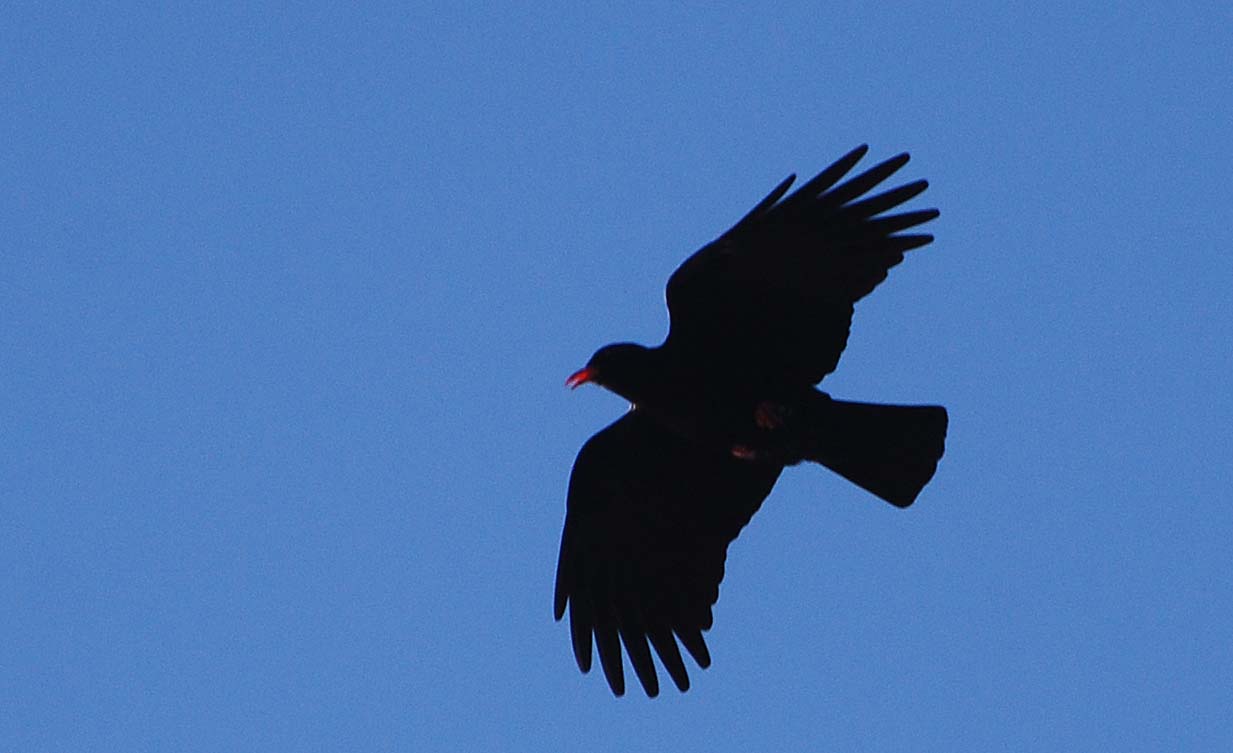
Before I carry on with Porthgwarra in this post. Jane and I were lucky enough to come across some Chough during this trip. Chough used to breed in Cornwall a long time ago before dying out, but just a few years ago they recolonised naturally from the continent and are here in small numbers. I can't reveal where we saw these birds, but it's safe to say that we were chuffed to see Choughs making a comeback! These two were happily digging away for grubs in the grass and then lifted off playfully (it seemed) to perform some aerial acrobatics.
I managed to snatch a couple of photos while they were flying above us. Their bright red slightly decurved bill and red legs can just been seen in these photos.
They also have a beautiful 'chow chow' cry which fits perfectly with their rugged clifftop existence! Beautiful birds!
Back at Porthgwarra and I left Jane to her sea-watching to wander along the cliffs to see what took my eye. I was in the mood to click with my camera! I loved the colours and textures of the cool sea and hot baked lichen on the cracked rocks in this shot (though it wasn't exactly hot on this day)!
I could never be bored watching a relentless sea crashing against immovable rocks. I could have sat watching this all day I think!

However, birds did 'call' to me after a while and I practised my actions shots on these Fulmars that were checking out the cliff face for suitable nesting sites.
They are such distinctive birds in flight with their stiff wing beats and are masters of the air. They are the closest we get to the Albatross in this country as they're part of the 'tubenose' family of seabirds.


As I make my way back to where Jane is still sea-watching (she likes to count when she's birding), I pass the coast guards house. What an amazing view from your workplace!!! (-:
There were some wonderful rock formations here. I'm not sure the camera does justice to this stunning scenery!
There'll be more from Cornwall in my next post...oh, and it's nice to be back! (-:

Friday, 7 January 2011

Apology!

Dear blogging friends. I just thought I'd better write a short note to apologise for the lack of posting recently. I think I've just needed a break from blogging. I hope to be back sometime soon. In the meantime, here is a photo taken back in November when Chris and I spent a couple of days down at Exmouth.
Happy New Year to you all!

Saturday, 27 November 2010

Odds and ends from Norfolk

Well, I seem to be apologising quite a bit recently for not keeping up with my blog posts. So, I'm sorry this has taken so long to get here. I think I've fallen off the edge of the blogging world at the moment! Here are some 'odds and ends' photos from my trip to Norfolk back in October. We were staying at a small town called Hunstanton on the North Norfolk coast. This is just about the only place along the coast in this part of the country that has cliffs.
We spent one day birding inland at a place called Sculthorpe. It's a nature reserve run by the Hawk and Owl Trust which has a mix of deciduous woodland and reedbeds.
I didn't get many photos of birds here, but found some other things to point my camera at! Below, some lovely peeling birch bark.
Common Darters are one of the latest flying of our Dragonflies. Here is a male basking in some sunshine on the broadwalk railings.
And the female doing the same not far away.
There are some nice fungi in the wood here. I took a couple of photos of ones I could see from the broadwalk.

From one of the hides, we waited patiently for this shy Water Rail to emerge from the reeds to feed on dropped seeds from the feeders above.
A windmill at Waxham on the east coast side of this large county.
One day we were lucky to be in the right place at the right time to experience a flock of 30 Bohemian Waxwings. It was right at the end of the day though so unfortunately the light was absolutely terrible for photography. However, it was lovely to stand just a few yards away from these beautiful birds as they communicated to one another with their amazing trilling call.

Right towards the end of our holiday, we stopped in at a Farm Shop that we'd passed several times during the week. They had a great selection of Apples and Pears as well as other seasonal vegetables and home made cakes etc.


I'll finish with a sunset at Warham on the coast. This is a great place for roosting raptors and owls. We spent a couple of evenings here watching Hen Harriers, Marsh Harriers, Merlins and Short-eared Owls.
Hope to be back blogging properly sooner or later.....maybe later! (-:

Monday, 8 November 2010

Thornham, North Norfolk coast

Sorry this has taken so long to get online, I've been caught up with other 'stuff'.
The small village of Thornham on the north Norfolk coast is one of my favourite places to visit, mainly for it's quietness and sense of being unchanged. I always seem to be here when the tide is right out (the sea is out there somewhere in the distance!) (-: This exposes a lot of muddy gullys for waders (shorebirds) to feed in.
It was quite a gloomy day with the occasional fleeting flash of sun between the brooding clouds.
Some of those sunrays seemed to shine on down towards the church in this photo below making for a lovely atmospheric shot.
It was that lush green field that Jane, Sue and I spent some time watching, attempting to identify a small flock of birds as Lapland Buntings or Lapland Longspurs as they are called in the States (a bird we all needed for our year lists). This flock of about 30-40 birds would occasionally get up from the field, fly around and around, this way and that for a bit and then descend back into the oblivion of longish grass! Very VERY frustrating! I've not seen or heard enough Lapland Buntings to be familiar with their call, but I tried to memorise it and promised myself, that when I got back home, I would check it out. Needless to say, when I played back the call, I just couldn't say for sure that it was what I'd heard that day. So, they didn't go on the list. Shame.
After our failed attempt with the Buntings, I consoled myself with taking photos of some waders. This Redshank was feeding close by in one of the exposed gullys. As you can see, its shanks were no longer quite so red!
Black-tailed Godwits are very similar to Bar-tailed Godwits, but have subtle differences. These two photos below are of a Black-tailed Godwit. The bill is straighter than the slightly upcurved bill of a Bar-tailed and the winter plumage on the back of the Black-tailed is plainer than on the slightly spangled back of the Bar-tailed. The Black-tailed also has slightly longer legs than Bar-tailed (a stumpy looking bird), though this is less noticeable in the first photo .
Man, that mud looks gloopy!
The next four photos were captured using the continuous shooting mode on the camera. This Curlew fancied a stretch!


The light was going fast and so we made our way back to the car. On the way back I snapped a shot of this Dunlin in winter plumage wading around in the river close the car (I think the tide was beginning to come in).
My last shot from Thornham is of boats waiting for that incoming tide.
Hopefully, it wont be such a long wait for my next post! (-:

Monday, 1 November 2010

Titchwell RSPB, Norfolk

Titchwell RSPB reserve is another 'must see' place to bird when visiting the north Norfolk coast. It has a variety of habitats which is always going to attract a proportionate variety of birds. There's some woodland as well as reedbeds, freshwater marsh, saltwater marsh and also the beach and the sea. For more information on this popular reserve click on the link above. Titchwell reserve is definitely a place that warrants the use of a scope, so maybe you can picture me (5ft 1" )juggling with a scope, bins, and two cameras! (-: In this photo, you can see the legs of my scope getting in the way of my shot (I guess I should've taken the time to put it down, but at the time, I was on a mission to get to the beach)!
The blue sky reflected beautifully onto the freshwater marsh which made the sandy tufty islands and banks really stand out in contrast.
Some, but not enough of the waders were reasonably close. This Redshank was obliging enough.
The calm day made for some nice reflections.
Here it's showing off the reason for its name! A common but very smart looking bird.
I enjoyed this Eurasian Teal with the early morning sun showing up his rich chestnut and teal green face. I also loved the patterns in the water here.
As he swam away from me, he made interesting textures in the water.
Here, showing the sun on that bright emerald green speculum.
One of the great sights and sounds I associate with Norfolk is the geese spectacle. Most of my previous trips here have been in the winter (February) when the geese are at their peak (in their thousands). In October they were just beginning to build up numbers and it was great to see this visible build up as the week went on. Below are a few Brent Geese flying over Titchwell reserve with their abrupt brrrrrup type call.
I finally made it out to the beach ( a good 20 minute brisk walk) and settled down with a few other birders to scan out to sea as well as pick off the names of waders feeding on the tideline. These included Oystercatchers, Dunlin, Turnstones, Sanderling, Bar-tailed Godwits, Curlew and Grey Plover (Black-bellied US)

Only one species of wader ventured further away from the tideline and closer to us. It was great fun to watch these Sanderling 'working' the soft sand here. Running along in their peculiar but endearing clockwork toy style. (One of my friends remarked that when there's a good bird to go for, I resemble a Sanderling somewhat! Hmmmm!) (-:
You can see in both of these photos, adult winter birds (very pale) and beautifully patterned juveniles.
I'll have more from Norfolk in the next post.